Abstract
Growing a Digital Humanities Culture
Twenty Years of the UNL Center for Digital Research in the Humanities
by Jeff Young
Read the full article below or view as a PDF.
Twenty years ago, the digital humanities seemed like a frontier. Some pioneering academics and librarians saw the still-new technology of the internet as a space for scholarly discovery and multimedia storytelling and a way to bring once-hidden texts to everyone, everywhere. They faced skepticism that it was all a fad and concerns that such projects might not be rewarded in professional reviews in fields for which “publish or perish” meant in printed journals and monographs. Significant early digital humanities experiments grew at the University of Nebraska– Lincoln, and scholars there decided in 2005 to set up an outpost on campus to foster and lead digital humanities work across disciplines, the Center for Digital Research in the Humanities (CDRH). Today, the center has made its mark across the nation and globally, supporting the Walt Whitman Archive, the Willa Cather Archive, Genoa Indian School Digital Reconciliation Project, Petitioning for Freedom, and other projects that collectively draw more than two million visitors a year. And the center has been a key convener of scholars advancing digital scholarship around the world. In the process, the center’s faculty, students, fellows, and affiliates have surfaced parts of history that had been silenced, enhanced education through adoption of its materials in countless classrooms, helped build tech platforms and standards to improve the sharing of scholarly materials, and nurtured the careers of a diverse collection of impactful scholars. On the occasion of the CDRH’s twentieth anniversary, this publication tells the story of the center’s rich human impact and looks at what’s next.
Introduction
The idea of the “digital humanities” has always represented a bigger mission than just applying the latest computer technology to scholarly work. From the earliest experiments at the University of Nebraska–Lincoln (UNL) and other colleges and universities, working in the digital humanities meant a culture shift in how scholars collaborate and share their work.
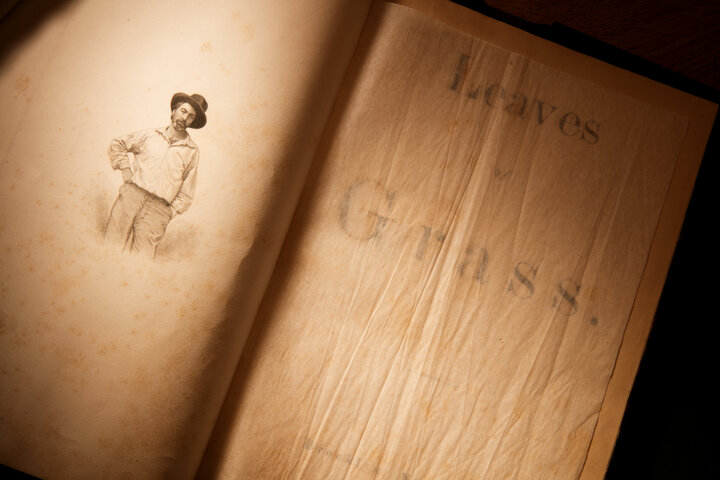
It’s about working across disciplines to break out of traditional academic silos. It’s about engaging with the broader public by making the raw materials of scholarship—often historic letters, photographs, or literary drafts—free and open to all. It’s about rethinking what is possible to publish, even for an audience of other scholars. After all, while it was necessary in a print age to agree on one definitive version of, say, Walt Whitman’s Leaves of Grass, in a digital age it’s possible to share the several, significantly different, versions that the author penned. And it’s about developing new techniques, enabled by technology, to unlock discoveries across literature, history, anthropology, art history, and any humanities field.
UNL has cultivated expertise in digital humanities since the early days of computer networks. And it has played a leading role in shaping the culture and practices of this emerging field.
A key driver of that work has been an interdisciplinary center at UNL called the Center for Digital Research in the Humanities (CDRH), which is recognized as one of the most prolific and impactful centers of its kind in the world.
The center has grown to support thirty-seven staff members and faculty fellows, published more than seventy-three projects, attracted tens of millions in grants, and won honors and awards both nationally and internationally.
The CDRH grew despite early skepticism toward the idea of digital humanities from scholars who charged that the approach represents overhyped “technophilia” that favors bean counting over deeper scholarship. That debate over the standing of the digital humanities in academe will likely continue, but the center’s projects have already proved their staying power and found an audience of scholars and the public beyond what early critics predicted was possible.
This year marks the twentieth anniversary of the CDRH, and to honor the occasion, this publication attempts to present a brief history of the center and share how its students and professors experienced it. More than a dozen of its leaders, professors, and alumni were interviewed to share their stories and key moments in the history of the center and to share its impact in personal terms.
Perhaps the biggest theme that emerged is how thoroughly the center has embraced an open and collaborative ethos, welcoming students and professors regardless of their technical skills, bringing what a former student referenced as “Nebraska nice” to the broader academic world, which can tend to be exclusive, hierarchical, and status-seeking.
From the beginning, the center’s leaders set the bar high for every project, consistently winning external grants and support. They have worked to build a base of financing and to codify practices that will ensure that digital humanities continues to play a key role at Nebraska and beyond.
Planting a Flag

Katherine Walter started at the University of Nebraska–Lincoln Libraries before electronic journals even existed. That was forty-five years ago, just a flicker of time in the history of human knowledge. But it was an era that today’s students might find hard to imagine—before laptops, smartphones, or websites.
The internet was a frontier at the time, and universities claimed early virtual plots in what was often called “cyberspace.” University researchers invented the internet in the 1960s, and by the mid 1990s when a researcher in Switzerland dreamed up a more user-friendly version called the World Wide Web, campuses were one of the few places with widespread access. So during the dot-com boom, while entrepreneurs tried overhyped online pet stores and short-lived delivery services, looking for what to do with this new tech, scholars began harnessing computers and networks for scholarship.
In the late 1990s, a professor at UNL, Susan J. Rosowski, had the idea to start a digital collection of the works of Willa Cather, whose elegiac prose celebrates life on the prairie (and who was an alum of the institution). Over time, Rosowski’s concept of the Cather Archive became a prototype for collaboration between scholars, technologists, librarians, and the academic press at the university. Together, they envisioned and started building an online collection that let anyone with a computer and internet connection call up primary documents that previously were available only to scholars who trekked to the physical library.
Soon after, another literary scholar with an interest in using the web for scholarship arrived on campus. Kenneth Price brought with him an ambitious effort to gather the myriad writings and drafts of Walt Whitman into a central online collection. He jokes that he charged into the work before he knew the complexities such an undertaking would involve. “There were so many decisions, and not many models to look to,” Price remembers. “We toyed with working with commercial publishers, but I’m glad that failed because open access allowed us to have a vast audience and a big influence.”
Price launched the project as a professor at the College of William & Mary in collaboration with scholars at the University of Virginia (UVA), which had emerged as an early leader in digital scholarship in the humanities and happened to be home to many of Whitman’s original writings. While Price was deciding whether to take the job at UNL, Walter reached out and told him that if he joined, she would make sure the library provided support from graduate students and staff members for his Whitman Archive.
“For print scholars that was a new idea, a brand new idea,” remembers Walter, who notes that especially among literary scholars, the norm was to toil alone amid stacks of books. “We offered him people.” At the time, she says, many humanities scholars’ reaction would probably have been “What do you mean I would want a team of people working with me on this?”
Her impression was that Price was floored by the offer—and tempted.
“It was a bit surprising,” remembers Price. And when he decided to join the faculty at Nebraska, he took her up on it.
Backed by that support from the Libraries, Price was able to win a substantial grant soon after he arrived on campus from the National Endowment for the Humanities (NEH) to add poetry manuscripts by Whitman to the archive.
Meanwhile, a professor in the Department of English had another idea for a big digital project. Steve Hilliard was interim director of the University of Nebraska Press, which was the publisher of Gary Moulton’s award-winning edition The Definitive Journals of Lewis and Clark, which spans some thirteen volumes in print. What if, Hilliard wondered, the university created a free digital version of the journals that made use of multimedia, including audio and video. And it could also include supplementary material to provide context, informed by other experts at the university, about the native plants and animals mentioned in the journal entries. This proved to be an early collaboration in digital humanities that involved the Center for Great Plains Studies and Nebraska Press—and that garnered significant funding from the NEH.
Other seeds were sprouting in different departments at Nebraska in this scholarly area that was then called “humanities computing.” At meetings, Walter remembers, a question bubbled up: “How can we make Nebraska this big thing in the humanities?”
A few other prominent universities had already staked a claim. Perhaps the most notable research center at the time was the one Price had collaborated with to start the Whitman Archive, the Institute for Advanced Technology in the Humanities, or IATH, which formed in 1992 with a grant from IBM.
At the time, having a willingness to forge ahead seemed more important than mere prestige when it came to digital projects, as the rules of mixing computing and humanities research were still being written. In fact, many universities with greater resources lacked a critical mass of scholars willing to jump into an untested area.
"So why couldn’t Nebraska be a world leader in the digital humanities?"
Of course not every professor believed in the approach in the early days. Folks in the Department of History in particular “initially had suspicions—they were resistant,” says Price. “They wanted to uphold standards, you know. Skeptics thought, ‘This stuff isn’t legitimate. It isn’t proven. It isn’t sufficiently peer-reviewed. How do you know it’s sustainable?’”
Another stumbling block was resources. Even back in 1998, the University Libraries had developed an informal effort called the E-Text Center to work with humanities faculty on campus and experiment with emerging technical standards, like the Text Encoding Initiative (TEI).
The informal approach had limits, though, as three UNL officials—Joan Giesecke, Beth McNeil, and Gina L. B. Minks—wrote in an article published in 2000 about those early efforts. “By now, you have no doubt noticed that the implementation of an E-text Center is going very slowly,” the article states. “With such limited funding, our ability to provide services is limited. However, the E-text effort has proven and is proving to be one way that we can at least slowly move forward in creating digital collections. The knowledge gained and skills learned in establishing a Center to work with faculty can benefit the rest of the Libraries.”
Walter and Price, with the help of other colleagues, began plotting to win more formalized funding for an official center. And they saw their chance in 2003, when the university made the strategic decision to target a select list of academic initiatives for extra support, in an approach leaders called Programs of Excellence. The scholars submitted a pitch that made bold claims about the possibilities in digital humanities for Nebraska to make a name for itself by creating what they dubbed the Center for Digital Research in the Humanities.
It helped that researchers at the university kept winning big-ticket funding awards for their online experiments. In 2003, the NEH gave the university a $223,000 grant to support The Journals of the Lewis and Clark Expedition Online.
“The central administration wasn’t used to people in the humanities bringing in these quarter-million-dollar grants, so that got their attention,” says Price. As top officials weighed which of the many proposals to accept as programs of excellence, “they wanted to fund something in the humanities,” Price says, and the digital humanities seemed like a good bet for future grants.
The proposal to create a Center for Digital Research in the Humanities made the cut. And by 2005, Walter and Price formalized their effort as an official university center, meaning the CDRH could hire its own staff and set up an office in the university’s central library. The two became the center’s founding codirectors.
“We were part of the second wave of digital humanities centers,” says Walter, noting that Michigan State University started its Matrix center around the same time.
Walter says, “we were really thinking about ‘How can we involve scholars in the process? How can we create new forms of scholarship out of what we’re doing?’”
As the center officially got underway, two donors—John and Catherine Angle—offered the university the chance to endow a new professorship, and the leaders of CDRH convinced the deans to focus the search on a scholar in the digital humanities. “I think it was the first endowed professor-level search in the digital humanities in the U.S.,” says Price.
He saw this as an opportunity to bring in a big-league player who could advise the new center and help take it to the next level. He and Walter suggested to the deans that UNL recruit a rising star in the digital humanities from UVA, Will Thomas, who had cofounded and led the Virginia Center for Digital History there and managed a high-profile project called the Valley of the Shadow, which had been one of the first works of digital scholarship to be published by W. W. Norton. That project presented more than five thousand pages of diaries, letters, newspaper articles, photographs, and other primary documents from two counties just a couple of hundred miles apart in the Shenandoah Valley from 1857 to 1870—Franklin County, Pennsylvania, in the North, and August County, Virginia, in the South. The book came with a CD-ROM with the materials and encouraged readers to explore the messy details of history on their own to get a richer understanding of the time, especially the complicated views on slavery in both the North and the South. As a New York Times article around that time noted, the work by Thomas, and his mentor Edward Ayers, represented “a new kind of popular history genre mixing multimedia and scholarship.”
“My sense was, it’s visible that he’s going to be a star,” Price remembers thinking about Thomas. Comparing the situation to a professional sports team snatching up a young star, he says it was a chance to score a team-changing player. “So we should do it now, when we can get him,” he remembers arguing. “If we make him this outlandish offer, they’re not going to be able to match it. We can compete with the top two or three centers in the world.”
The offer Nebraska made Thomas: a jump to an endowed full professorship, a highly unusual chance for this young scholar to vault up the academic ladder.
It was an offer he couldn’t turn down. “What Nebraska did was say, ‘We want you to come here,’” Thomas says, noting that the research funds that came with the position were “substantial.” “They said we are building a center, and we want you to be part of that.”
At a time when much of the academic discipline of history was “looking askance” at digital projects, Thomas says, it was refreshing to join a department where almost everyone was at least willing to consider trying the digital humanities.
“Our approach was, ‘We’re going to try to build the strongest, most diverse digital scholarship across the department,’” he says. And he brought in more people to the university with experience in digital humanities, including helping to recruit Stephen Ramsay from UVA (now a professor of English at Nebraska who describes himself as obsessed with computer languages and with the question of how algorithms can change the understanding of literature).
Thomas worked in partnership with Walter and Price, the codirectors of the new CDRH.
Perhaps their most impactful collaboration involved coordinating a “cluster hire” of faculty members with an interest in digital projects. This might have been the first time UNL used the strategy, a coordinated recruitment across departments of faculty members with a shared expertise, focus, or approach.

“We were able to say that we had already planted a flag in this area, and we already had prominence, and if the university were to invest, we could go from being prominent to being potentially dominant in digital humanities nationally and internationally,” says Price, explaining the argument made for the cluster hire.
Between 2009 and 2013, the cluster hire brought in seven professors with digital humanities expertise in art history, anthropology, classics, English, and history. That effectively doubled the center’s faculty at the time.
“I was one of them,” remembers Carrie Heitman, an anthropologist who is now a professor in the School of Global Integrative Studies and serves as associate director of CDRH. “There was a lot of interdisciplinary energy,” she remembers, since there were so many new faculty involved in the center bringing different expertise.
The cluster hire also wove digital humanities into new parts of campus, since the faculty members all served as fellows in CDRH as well as holding faculty appointments. “It was kind of like a spiderweb in a way,” says Walter, “of reaching out and pulling people in and giving them a place they could be separate from their own department.”
"While there have been these splashy hires of outsiders, the center has mainly cultivated an ethos of growing local talent through providing training, mentorship, resources, and opportunities to collaborate."
Just ask Emily Rau. When she was choosing grad schools back in 2014, she picked Nebraska, rather than a university closer to her hometown in New Jersey, because of its commitment to digital humanities and the chance to work on the Willa Cather Archive.
Rau’s degree was in American literature, not in library science, so she wasn’t necessarily destined for a career in the University Libraries, she says. But she started working on the Cather Archive soon after she arrived on campus, and she fell in love with the work. “I did not expect to stay here,” she says. “I expected to do my PhD and move wherever I had to go to get a job.” She did receive an offer from another university, but the University Libraries counteroffered with a tenure-track position to keep her around. “I didn’t even think that was possible,” she says. “Sometimes universities feel like they need to bring in external people to feel like they’re competitive. UNL seems more invested in the local community than other places.”
Today, Rau serves as editor of the Willa Cather Archive, which continues to evolve, even as it stands as a model. And Rau spends plenty of time helping current graduate students develop skills and experience so they can land great jobs and spread the techniques to other projects or other institutions. And it feels like home.
“I just bought a house on Friday, so I’m never leaving,” she says, noting that she feels deeply rooted to the university and the center.
Even from the early days, the center’s leaders have worked to build a solid foundation for the CDRH to prepare for a day when people no longer see “digital” projects as novel and exciting. That has meant setting up an endowment for the center with the University of Nebraska Foundation. Thanks to a challenge grant from the NEH, that endowment has grown to more than $1.5 million.
“What we basically said was it was for mentoring the next generation of humanities scholars—that was the pitch,” explains Walter. “That endowment has really helped.”
Changing Scholarship
When Katrina Jagodinsky joined the faculty of UNL’s Department of History in 2012, she had no training in digital scholarship and no plans to get involved.
But she found herself surrounded by graduate students working on projects for the CDRH, and she attended some of the center’s open sessions during which students and professors describe projects they’re working on and seek input.
“A lot of lightbulbs were going off for me,” remembers Jagodinsky. “I focus on marginalized people,” she adds, noting that her research explores the history of Native Americans and other people who audiences often “assume aren’t numerically significant actors in the past.” As she dug through various archives for her work, however, she found Native peoples routinely represented in legal records of nineteenth-century America. And she realized that digital techniques could help explain complex stories she was uncovering as she dug through boxes in physical archives.
“As I was talking with graduate research assistants, I realized that digital humanities would allow me to combine quantitative and qualitative approaches,” she says. Her interest was in revealing human stories that had been forgotten but also in finding patterns among those nuanced stories. “I thought, ‘I better jump on this train or I’m not going to be able to do the project I want.’”
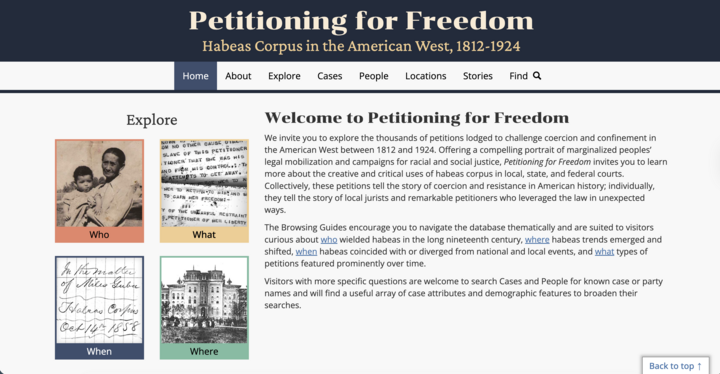
The scholar was digging through the texts of legal filings in the American West from 1812 to 1924, with a focus on understanding how ordinary people challenged their arrests, deportations, and other legal actions against them. A digital archive, she realized, would allow unprecedented analysis across these disparate documents and let anyone explore the raw materials.
At most universities, she says, mounting such an archive would have been a tough sell. After all, she started with no skills in building or harnessing such archives. “I knew the research questions I had, but I wasn’t sure what I would need to answer those questions,” she remembers. “CDRH helped me figure out how—and which grants to write to get funding for deeper training.”
Jagodinsky decided to go big, applying for a National Science Foundation (NSF) grant to scan and analyze legal petitions from Arizona, Iowa, Kansas, Missouri, Nebraska, New Mexico, Oregon, and Washington. It was a different kind of project than the center’s other signature efforts like the Willa Cather Archive or the Walt Whitman Archive. “Every legal case is different,” the scholar explains. But leaders of the center enthusiastically supported the idea and jumped at the challenge to build a new technical framework for it.
NSF awarded Jagodinsky’s project nearly half a million dollars, and to date Jagodinsky has led a team of student research assistants to scan more than two thousand legal cases to create a public archive called Petitioning for Freedom.
“It is yielding some field-shifting understanding of law in the American west,” says Jagodinsky.
“A lot of people would assume that Native people weren’t using local courts in the 1800s,” she notes, because they were not recognized as U.S. citizens until 1924. “But we learned that they appear in every state—not in really large numbers, but they are everywhere.”
The story embodies the center’s approach—and its impact. The playbook has been to set a high bar for projects, win external funding, prioritize the sharing of ideas across disciplines and with tech experts, and encourage mentorship to bring in more scholars.
And while the research questions have led the center to support innovative ideas in using computing for humanities research, CDRH has avoided chasing the latest tech fads.
“The ethos is, ‘Let’s take this slowly. We’re in this for the long haul; we’re not distracted by shiny objects,’” says Julia Flanders, a professor of practice in English and the director of the Digital Scholarship Group in the Northeastern University Library who has long worked informally with scholars at the CDRH. “It’s not about heated seats and cupholders; it’s about equity and safety,” she adds.
That approach has given the center’s projects staying power, even while other universities have seen efforts fade as technologies change, and as some have wondered whether digital collections can last in the way that printed books do.

The CDRH has also won a reputation for driving broader discussions of where the digital humanities should go next.
As proof of that leadership, in 2013 the center hosted the biggest annual international conference in the digital humanities, the gathering of the Alliance of Digital Humanities Organizations. More than five hundred scholars from some twenty-four countries traveled to Lincoln for the weeklong event.
“It was an acknowledgment of CDRH’s being on the map,” Flanders says.
And every year the center brings together digital humanities leaders from around the country for the Nebraska Forum on Digital Humanities. The gathering has taken many forms over the years, but the event aims to showcase the work of early-career scholars in the digital humanities in a discussion of pressing issues in the field. The 2024 forum tackled how to use artificial intelligence tools in digital cultural heritage in responsible and equitable ways.
“It’s one of the longest-running digital humanities convenings out there,” notes Thomas, who started the tradition more than fifteen years ago as, initially, the Nebraska Digital Workshop. “To get the invite to Nebraska to present has become a sign of the impact of someone’s scholarly work.”
Over the years, the center has also worked to improve the standards and practices around translating physical documents and artifacts into digital formats. In fact, CDRH fellows and faculty members often light up when talking about “metadata.” That’s the information coded about each digital object that is often invisible to the average reader but helps in searching and in packing in additional background information that might be useful to future scholars.
“When you get on Spotify and you say, ‘Play Taylor Swift, but play Taylor’s version,’ metadata is helping get you to the right track,” says Laura Weakly, a UNL metadata encoding specialist. “It’s a bit of information that gets you to the right thing.”
From the center’s earliest days, its leaders worked to find the most robust way to tag and label their materials. This attention to metadata is demonstrated in the National Digital Newspaper Program, which has involved most states across the United States, including Nebraska. “If you want to search across hundreds of newspapers and ensure the longevity of the data, adherence to standards is crucial,” Walter and Weakly agree.
"One of CDRH’s mantras has long been to surface previously unheard voices, and that has often meant deep engagement with people with direct ties to the documents and artifacts scholars are bringing into digital collections."
For Heitman, that has involved working directly with members of American Indian tribes to better understand objects unearthed in archeological digs. Her professional mission is to build collaborative, open-access cultural heritage resources.
“The driving ethos is that it’s not a project that I bring to a community but something that emerges as a priority to them,” she says.
Heitman remembers an event she helped organize that brought in potters from the Hopi and the Pueblo of Zuni tribes to advise her research team on the cultural meaning and importance of a set of artifacts. “What was moving for me is that these objects elicit knowledge. They elicit stories and an embodied way of understanding ancestors,” she says. When she looks at a bowl from a historical dig, her impulse is to tag it with objective details like the kind of glaze used or its shape. “So to watch potters handle the object and understand that the patina and the inside surface of the bowl indicated that there would have been animal meat that was served out of it because they could see the sheen and feel the gloss and sort of know what types of food people would have eaten, that is embodied knowledge I do not have.”
These community interactions not only better inform the digital collections, she argues, but they can also spark meaningful moments for the participants. “It can become a prompt for conversations about, ‘What's the Hopi word for this?’ ‘Who in this room knows that word?’ ‘Oh, why doesn’t everybody know that word?’ ‘Why is it just this one woman elder who knows that word?’ It’s about understanding the object as generative.”

Project leaders at CDRH regularly consult community members as they make decisions on their digital projects. For instance, the center’s Genoa Indian School Digital Reconciliation Project hired community advisors and met with them monthly at the outset of the project.
“Early on we thought members of the tribal community might have sensitivities in releasing the names of family members,” says Elizabeth Lorang, dean of the Libraries, who previously co-led the project, noting that many of the documents they have digitized contain names and other personal details. “But actually the community advisers said, ‘This is the full story, and we don’t want to limit access in any way.’”
Talk to any researcher involved in the CDRH, and you’re also bound to hear about surprising moments of discovery that could only have happened because of the new digital techniques they use.
“A lot of it is how you can manage a whole lot of documents and how you can arrange them and make them searchable,” explains Jeannette Jones, a history professor at the university and a fellow at the CDRH. In her own research on cultural ideas about Africa among people in the United States between 1862 and 1919, her findings have “challenged interpretations that we thought were set because we were able to deal with only a small number of documents.”
For instance, by mapping large amounts of data about trends in diplomatic services in Africa during the time period, she curated a series of maps that users can interact with to see how U.S. foreign policy regarding Africa changed throughout a set time period in, say, where U.S. diplomatic staff were placed in Africa to get a sense of where information was being gathered by government officials.
For Andrew Jewell, now codirector of the CDRH, working with a digital document in the center’s Walt Whitman Archive led him to notice something others had missed. While he was a graduate student, he was able to prove that the poem “I’ll Trace This Garden,” long thought to be written by Whitman, was actually the Civil War folk song “Johnny Is Gone for a Soldier.”
“Whitman was writing out someone else’s work, but it was published as a Whitman poem,” Jewell says. “What that illustrated for me in my first months working on a digital project was that expanded accessibility and searching could lead to new discovery.” He published his findings in the academic journal Walt Whitman Quarterly Review.
More recent students are finding new ways of harnessing digital tools to scour millions of documents for patterns and identifications. Lorang, before becoming dean of the Libraries at UNL, did extensive research on poems published in newspapers in the mid-nineteenth century. At the CDRH, she collaborated with a computer scientist to use machine learning to identify poetic work in old newspapers, allowing scholars to identify and analyze such works “at scale.”
The center has found ways to support graduate students outside of traditional courses. Since 2022, a Digital Humanities Summer Fellows Program has supported four students each year with funding, training, and mentorship. “Fellows also support one another through conversation, critical engagement, and knowledge exchange in a collaborative environment,” says Heitman.
These days, many of the hundreds of graduate students trained at CDRH serve as professors and leaders in digital humanities at universities around the country. And they bring lessons they learned at Nebraska to centers of their own.
One example is Gabi Kirilloff, an assistant professor of English at Washington University in St. Louis.
Back when she was a graduate student at Nebraska, she spent five years working on the Willa Cather Archive. “It was incredibly collaborative,” she remembers. “We were all working in the same physical location together, reading letters together and saying, ‘Hey can you look at my screen to see if I’m doing the right thing?’”
Looking back, she realizes little things she didn’t appreciate at the time. For instance, Jewell, who was the editor of the Cather Archive at the time, regularly let Kirilloff and others from the Cather Archive use the table in his office for their regular meetings while he sat doing his work. “As a grad student it felt very cool,” she remembers. “I’m in this office space with this important professor. I didn’t really think about how generous he was being in sharing his space with us.” The overall vibe at the center was “warm, but also professional,” she says. “They were treating us as equal collaborators but also mentoring us.”
Today she hopes to bring that collaborative spirit to a center she is starting at WashU, the AI Humanities Lab. She says she is even trying to set up the space so there are open areas for students and professors to work together.
“It was really important,” she says, “for us to find a room where we can all sit around a table together.”
Deepening Public Understanding
When a teacher in Thailand submitted a photograph to accompany an article about teaching Willa Cather’s works in that country, she posed proudly in front of a projection of the Willa Cather Archive website, holding a stack of the author’s books.
When Jewell, CDRH codirector, stumbled upon that image, he considered it proof of the power of putting curated collections out on the web where they can take on a life of their own.
“You can see she has a sense of ownership in the website,” he says of the woman in Thailand. “It says, ‘This is our thing.’ And I love that.”
Students and scholars in schools and colleges around the world regularly consult the Willa Cather Archive, the Walt Whitman Archive, and the dozens of other online collections produced by CDRH to write research papers or read portions assigned by their instructors. The fact that these works are free and require no password or registration bolsters their use—not just in educational settings, but for anyone with an interest in the material.
“Wikipedia articles look really different when you have these primary documents out there,” notes Jewell, adding that works from CDRH often show up as sources in the online encyclopedia that anyone can add to and edit, provided they cite legitimate information sources.
The center has long worked to keep its collections welcoming to both experienced researchers and anyone who might stumble upon the websites.
Karin Dalziel remembers one meeting in developing the Civil War Washington project in particular. “We had all of these very, very detailed conversations about how exactly the navigation would be,” says Dalziel, who is an assistant director in the University Libraries and leader of the CDRH development team. She was new to the center at the time, coming in after working in public libraries, advertising, and retail, and she remembers initially feeling intimidated at a table full of folks with PhDs in various disciplines. Once she worked up the courage, though, she offered a useful critique of some of the proposed language her scholarly colleagues confidently pushed. “The word you used is too academic and people in the public are not going to know what that means,” she remembers saying. So she convinced them not to label a section of the site “realia,” even though historians know it as a category of miscellaneous artifacts. “In navigation, you need words that everyone knows.”
Dalziel says she soon realized that her input was welcome. In fact, in design meetings at the center, planners often plot out how CDRH projects will serve various personas, imagining, say, a high school student visiting the site for a class project or a family member doing genealogical research.
People researching their family trees turn out to be a big audience, especially for the thousands of articles from Nebraska newspapers that CDRH has published as part of the National Digital Newspaper Program.
“People are like, ‘I want to know if my grandma was on the cheer squad,’” says Laura Weakly, the metadata specialist, who has worked on the center’s effort to put the entire archives of the university’s student newspaper, The Daily Nebraskan, online.
And the CDRH has run plenty of public events over the years to engage the broader public in the material they explore.
In 2018, the center’s Willa Cather Archive hosted a series of events to celebrate the one hundredth anniversary of the author’s signature novel, My Ántonia. That included a field trip that provided a guided tour of Cather-related sites in Nebraska, including the Willa Cather Memorial Prairie, with an emphasis on how literature can encourage people to care about the environment. And the center helped host a picnic in collaboration with a nonprofit that prioritizes working with immigrants and refugees, while participants read passages from My Ántonia in four different languages.
“It was such a beautiful event,” remembers Emily Rau, current editor of the archive. “It was just fully open to the public. You had an older white guy who’s farmed his whole life sitting next to a Yazidi man and his family who had just moved here like five years ago, talking to each other and finding common ground.”
The CDRH also takes on projects to expand the public’s understanding of their own community and history.
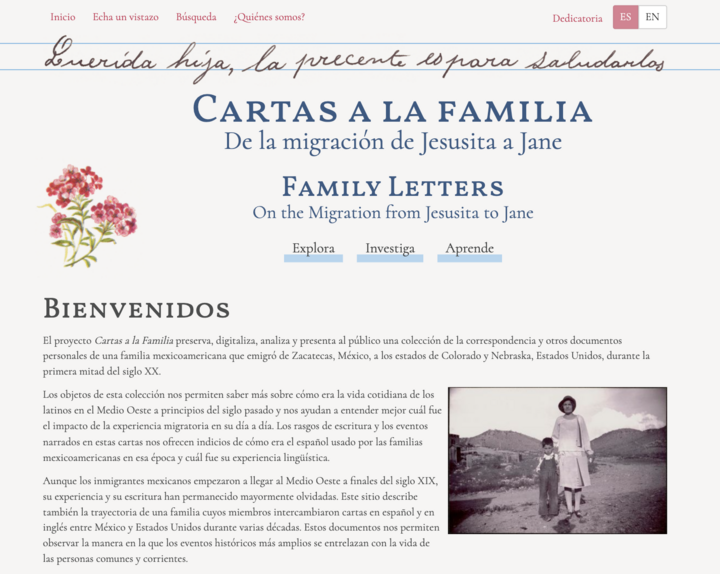
One example is Family Letters, a project led by professor Isabel Velázquez, which digitized a trove of letters, photographs, and other personal documents from a family who immigrated from Mexico to Colorado and Nebraska during the first half of the twentieth century. That’s a time period not usually thought of as a time of migration from Mexico to the region.
“People might know about the history of German immigrants there, or Polish, but they may not know about Hispanic people,” says Jennifer Isasi, who worked on the project when she was a graduate student. “You can see the life of a Hispanic family in Nebraska on a daily basis, a regular family trying to make a new life in the state. And it is more complicated than they might think.”
Isasi, who is now the assistant director of the Office of Digital Pedagogies at Pennsylvania State University, remembers meeting with the woman who gave the university the collection, Jane Shanahan. “We sat down for hours and hours and hours, and she told me who was in the photos so I could write that information for the archive,” Isasi adds. The project is powerful, she says, because “it is a very good way to learn about the life of regular folks in the area and the migration experience to somewhere where you don’t speak the language and know anyone.”
Isasi can relate, having grown up in Spain and moved to the U.S. for graduate school. She notes that most of the undergraduates who worked on the digital project were of Hispanic heritage. For the professor leading the effort, Velázquez, an associate professor of modern languages and literatures at UNL, “the entire project was about connecting students to their heritage through the archive as well.”
The center’s projects also link users to stories of people from the past from vastly different backgrounds and experiences with a goal of revealing how much we all have in common. That was the experience for UNL undergraduate Ethan Tylski, who worked on a project for the CDRH while he was preparing to be a teacher.
“My professor, Beth Dotan (a CDRH fellow), sent me an email one day and asked to meet up, and she had something to ask me,” he remembers. “She said, ‘We’re doing this research project to document survivors and people who actually saved people from concentration camps in WWII. Would you like to be part of it?’” The project is called Nebraska Stories of Humanity: Holocaust Survivors & WWII Veterans, Network Portal & Education Website.
He jumped at the chance. “In a lot of ways it was the dream of a lifetime for a social studies education major,” he says.
Tylski spent a couple of hours a day over a period of years combing through the soldiers’ letters—intimate dispatches to spouses and girlfriends that mixed the mundane and the harrowing. The student felt he got to know the soldiers as he read through their personal correspondence.
One letter by a combat medic named Clarence Williams still sticks with him. Sent to the soldier’s wife, Gretchen, on April 30, 1945, it started off talking about hard-boiled eggs (he was sick of eating them) and how his unit had just finished a boring day of making slow progress in their convoy. Then, in a sudden turn, Williams described an experience “that I will never forget as long as I live.”
Williams wrote: “I had read a lot about concentration camps and the brutal treatment given to the prisoners but often wondered if it were all true. Now I can vouch for it. The camp covered an area of probably ten square blocks and much of it was surrounded by high cement walls with barbed wire on top and electric wires over those. A railroad runs through the camp and we saw an entire train of box cars with dead human bodies that they had no time to dispose of. Several press photographers were there so if you see any pictures in the newspaper or Life Magazine I would appreciate your letting me know and saving them for me. Some of our medics are in the pictures and they may even be shown in the movies as there was one movie camera there.”
Sure, Tylski says, he had heard about the liberation of concentration camps. “But to spend so much time with this guy learning about his story, it really made it feel a lot more real, and it made me feel the empathetic value of studying history.”
Today, Tylski teaches eighth-grade social studies at Goodrich Middle School in north Lincoln, and he has recommended the online archive to a colleague who teaches high school. “In history education, we’re doing a lot more reading of documents and letters—primary documents instead of textbooks,” he says. “It teaches skills of looking at primary sources and these critical thinking skills. My experience with research really helped me when I went into the teaching profession.”
Conclusion
When she wasn’t helping found and lead the digital humanities center at UNL, Katherine Walter applied her organizational skills to helping start a large neighborhood garden.
As with the CDRH, Walter decided to go big—and to create what she and others hope will become a model for collaboration. Some twenty-four households are involved, and participants have planted more than sixty fruit trees, brought in beehives and chickens, and raised vegetables so families can source some of their own food. She and her husband, who run the garden together, went from knowing only a few people in the neighborhood to working regularly with nearly everyone on the garden project. The Hawley Hamlet, as the garden is called, has been praised in articles in the Omaha World Herald, Upworthy, and Mother Earth News.
“We encourage visitors and encourage you to wander through and think about what can be done in your own block,” reads a brochure for the neighborhood garden.
In many ways the community garden and the CDRH follow the same mantra—that bringing together people who haven’t worked together before can inspire significant change.
“It’s not built around a cult of personality,” says Jagodinsky, the associate history professor at UNL who works with CDRH, noting that the center has always focused on a mission of supporting digital humanities work, rather than any particular scholar or project.
One goal has been to make sure the center lives on, no matter who is leading it, by diversifying funding with a mix of federal, state, and university grants; by setting up an endowment; and by establishing clear governance structures to make sure professors and students affiliated with the center get recognized for their work.
In many ways, the digital humanities are thriving these days. It’s easier than ever for scholars to use free tools, such as Omeka.net, to spin up online projects that once required a team of experts to produce. “You can get to a fully functioning website pretty quickly,” says Dalziel. “It’s a world easier than it used to be.”
The boom in artificial intelligence promises to be the “next frontier” in digital scholarship, at least according to the keynote at this year’s international conference on the digital humanities.
But recent actions by the Trump administration have caused an unexpected storm for the CDRH. Without warning, the NEH terminated $100,000 in funding for the Willa Cather Archive in April. Six other NEH grants for the center were slashed as well, including $60,000 for the center’s Genoa Indian School Digital Reconciliation Project, a grant that was just two months shy of wrapping up, and another to the Nebraska Digital Newspaper Project, which was in the process of digitizing articles from the South Omaha Stockman, a now-defunct newspaper from the late 1800s that covered the stockyards in South Omaha.
But since in many ways the center is itself a kind of community garden for scholarship, it has, as one member of the center recently put it, “supported multiple crops at once because they will support each other.”
And in this shifting environment, the center plans to lean into more collaborations, even doing more to work with organizations outside the academy.
“In our twentieth year, we are imagining a vibrant future,” says codirector Andrew Jewell. “The work we do is adaptable to changing circumstances because fundamentally it is about making good information about our shared cultural heritage more widely accessible.
“And that need will always be there.”
About Jeff Young
Jeff Young is an editor, reporter, and podcaster focused on higher education and how technologies are reshaping our world.